Jun 26, 2026News & Insights
Professional Guide: Lighting Installation Distances and Precautions
Lighting Installation Distances and Precautions
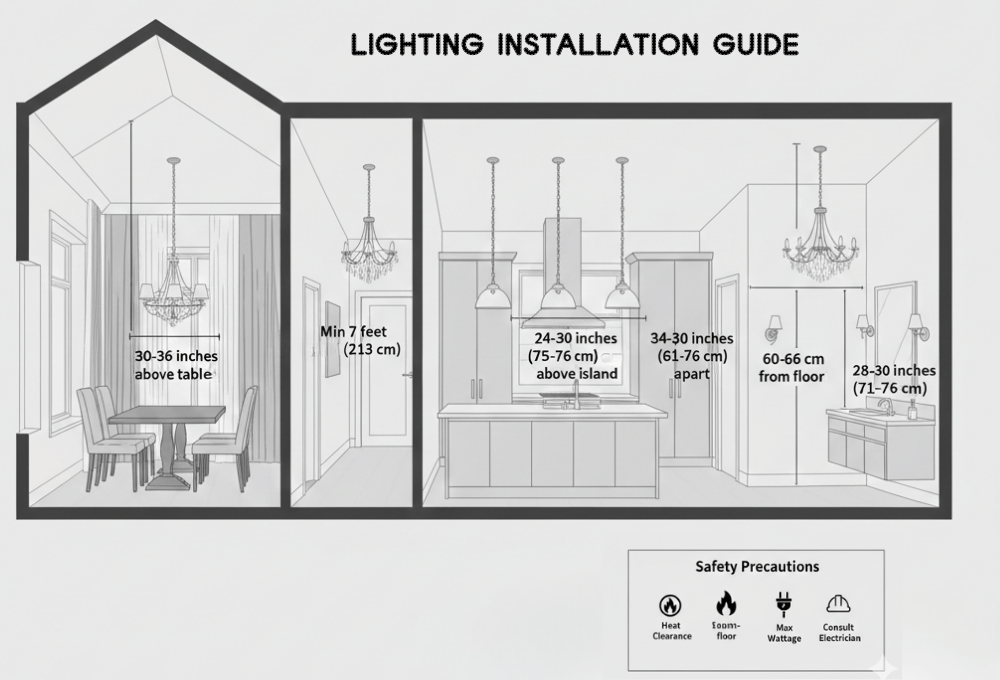
Professional Guide: Lighting Installation Distances and Precautions
This guide covers the standard spacing and essential precautions for traditional decorative lighting.
1. Pendant Lights and Chandeliers
Installation Distances:
- Over a Dining Table: The bottom of the fixture should hang 30 to 36 inches (75–90 cm) above the tabletop. For higher ceilings (above 8 feet (244 cm)), add 3 inches (7.62 cm) for every additional foot (30.5 cm) of ceiling height.
- Over a Kitchen Island: Maintain a distance of 30 to 36 inches (75–90 cm) from the island surface. If installing multiple pendants, space them roughly 24 to 30 inches (61–76 cm) apart to ensure even light distribution.
- Entryways and Hallways: The bottom of the chandelier should be at least 7 feet (213 cm) from the floor to allow for clear passage.
Precautions:
- Weight Support: Traditional decorative chandeliers can be heavy. Ensure the junction box is "fan-rated" or capable of supporting the specific weight of the fixture.
- Heat Clearance: Because traditional bulbs generate heat, ensure there is at least 6 inches (15 cm) of clearance between the bulb and any flammable materials (like fabric shades or plastic decorations).
2. Wall Sconces
Installation Distances:
- General Living Areas: Mount sconces 60 to 66 inches (152–168 cm) above the floor. The eye level is the standard benchmark.
- Bedside Lighting: If used as reading lights, the bottom of the shade should be roughly 20 to 24 inches (51–61 cm) above the top of the mattress.
- Hallways: Space sconces 6 to 8 feet (183–244 cm) apart to avoid dark spots and create a rhythmic visual flow.
3. Ceiling Mounts (Flush and Semi-Flush)
Installation Distances:
- General Spacing: For ambient lighting, space fixtures to ensure light overlaps. A common rule is to divide the ceiling height by two (e.g., if the ceiling is 8 feet (244 cm) high, space lights 4 feet (122 cm) apart).
Precautions:
- Insulation Clearance: For recessed or close-to-ceiling traditional lamps, ensure there is proper "IC Rating" (Insulation Contact) or maintain a gap from attic insulation to prevent fire hazards caused by heat buildup.
4. Bathroom Vanity Lighting
Installation Distances:
- Side Sconces: Mount them on either side of the mirror, roughly 60 inches (152 cm) from the floor and 28 to 30 inches (71–76 cm) apart. This eliminates shadows on the face.
- Over-Mirror Lights: Mount the fixture 75 to 80 inches (191–203 cm) above the floor.
Precautions:
- IP Ratings: In bathrooms, ensure the fixtures are Damp Rated or Wet Rated to handle moisture and steam.
General Safety Precautions for Traditional Light Sources
- Wattage Limits: Never exceed the maximum wattage labeled on the lamp socket. Traditional bulbs (incandescent/halogen) draw more power and generate significant heat; exceeding the limit can melt the socket or cause a fire.
- Heat Dissipation: Traditional decorative lamps require better ventilation than LEDs. Do not install them in tightly enclosed glass or plastic containers unless the fixture is specifically designed for it.
- Dimmers: If your decorative lamp uses traditional bulbs, ensure you use a leading-edge dimmer compatible with incandescent loads. This allows for smooth ambiance control without flickering.
- Handling Halogen Bulbs: If your fixture uses halogen capsules, do not touch the glass with bare hands. The oils from your skin can cause the bulb to overheat and shatter. Use a clean cloth or gloves.
- Circuit Load: Traditional bulbs consume more Amps. Ensure the total wattage of all lamps on one circuit does not exceed 80% of the circuit breaker’s capacity.
Pro-Tip for Customers:
Always consult a licensed electrician for installation to ensure compliance with local building codes and to guarantee that your beautiful new decorative piece is safe for years to come.